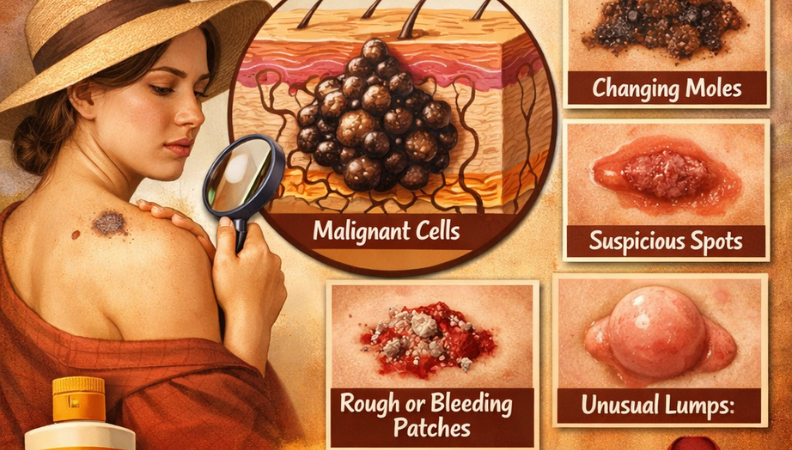
Early Signs of Skin Cancer You Should Never Ignore
Skin cancer is one of the most common types of cancer worldwide, yet many people fail to notice its early warning signs. The good news is that when detected early, most skin cancers are highly treatable. The challenge is that the early symptoms are often subtle and easy to dismiss as harmless skin changes.
Understanding what to look for can make a critical difference in early diagnosis and treatment. In this guide, we’ll explore the early signs of skin cancer you should never ignore, why they occur, and when to seek medical advice.
Why Early Detection Matters
Skin cancer develops when abnormal skin cells begin to grow uncontrollably. This often happens due to damage from ultraviolet (UV) radiation from the sun or tanning beds. The three most common types of skin cancer are:
- Basal Cell Carcinoma (BCC)
- Squamous Cell Carcinoma (SCC)
- Melanoma
Among these, melanoma is the most dangerous because it can spread quickly to other parts of the body. However, when caught early, the survival rate is significantly higher.
Regular skin checks and awareness of early warning signs can help you detect potential problems before they become serious.
1. A New Mole or Growth on the Skin
One of the most common early signs of skin cancer is the appearance of a new mole or growth that wasn’t there before.
While many moles are harmless, a new mole that changes quickly in shape, size, or color could indicate melanoma. Pay special attention if the mole appears suddenly and looks different from others on your body.
Dermatologists often refer to this as the “ugly duckling sign” — a mole that stands out from the rest.
2. Changes in an Existing Mole
A mole that begins to change over time should never be ignored. The ABCDE rule can help you identify suspicious moles:
- A – Asymmetry: One half of the mole does not match the other.
- B – Border: Edges are irregular, blurred, or jagged.
- C – Color: Multiple colors such as brown, black, red, or white appear.
- D – Diameter: Larger than 6 mm (about the size of a pencil eraser).
- E – Evolving: Any change in size, shape, color, or texture.
If you notice any of these changes, it is important to consult a dermatologist.
3. A Persistent Scaly Patch
A rough or scaly patch that does not go away may be an early sign of squamous cell carcinoma.
These patches often:
- Appear reddish or brown
- Feel dry or rough
- Sometimes itch or bleed
- Grow slowly over time
They frequently appear on areas exposed to the sun, such as the face, scalp, ears, neck, and hands.
4. A Wound That Doesn’t Heal
A sore that refuses to heal or keeps reopening can be a warning sign of skin cancer.
Basal cell carcinoma often appears as:
- A small pink or red bump
- A shiny or pearly growth
- A sore that crusts, bleeds, or scabs repeatedly
If a wound lasts longer than three weeks without healing, it’s best to have it checked by a healthcare professional.
5. Itching, Tenderness, or Pain in a Mole
Most moles are painless. If a mole becomes itchy, tender, or painful, it could indicate abnormal cell changes.
Other symptoms that may accompany this include:
- Bleeding
- Oozing
- Swelling
- Formation of a crust
While irritation may sometimes be harmless, persistent discomfort should be evaluated.
6. Dark Streaks Under Nails
Skin cancer doesn’t only appear on exposed skin. Melanoma can also develop under fingernails or toenails.
Warning signs include:
- A dark vertical line under the nail
- Nail lifting from the nail bed
- Pigmentation spreading to surrounding skin
This type of melanoma is called subungual melanoma and is often mistaken for a bruise.
7. A Shiny or Translucent Bump
Basal cell carcinoma sometimes appears as a shiny bump that may be pink, red, or skin-colored.
These bumps may:
- Look pearly or waxy
- Have visible blood vessels
- Slowly increase in size
- Bleed easily
They are most commonly found on sun-exposed areas such as the face or neck.
How to Check Your Skin at Home
Performing a monthly skin self-exam can help detect early changes.
Follow these steps:
- Stand in front of a full-length mirror.
- Examine your face, neck, chest, and torso.
- Check arms, underarms, and palms.
- Look at the back using a hand mirror.
- Inspect legs, feet, and between toes.
- Don’t forget your scalp and behind your ears.
Taking photos of moles can help you track changes over time.
When to See a Doctor
You should consult a dermatologist if you notice:
- A new or unusual skin growth
- A mole that changes shape or color
- A sore that does not heal
- Bleeding or itching moles
- Rapidly growing skin spots
Early diagnosis significantly improves treatment outcomes.
Interactive FAQs About Early Signs of Skin Cancer
1. What is usually the first sign of skin cancer?
The first sign is often a new mole or a noticeable change in an existing mole, including changes in size, color, or shape.
2. Can skin cancer appear suddenly?
Yes. Some forms of skin cancer, especially melanoma, can appear quickly and change rapidly within weeks or months.
3. Does skin cancer always hurt or itch?
No. Many early skin cancers are painless and may not cause itching or discomfort, which is why visual changes are important to monitor.
4. Are all dark moles dangerous?
Not necessarily. Many moles are harmless, but irregular, changing, or unusually colored moles should be examined by a dermatologist.
5. Can skin cancer develop in areas not exposed to the sun?
Yes. Skin cancer can occur on areas like the scalp, soles of the feet, under nails, or even inside the mouth, although sun exposure remains the primary risk factor.
Final Thoughts
Skin cancer is highly treatable when detected early, but ignoring warning signs can allow it to progress. Paying attention to new growths, changes in moles, and unusual skin patches can help you catch potential problems early.
Make it a habit to perform regular skin checks and schedule professional skin examinations when needed. When it comes to skin cancer, early awareness truly saves lives.